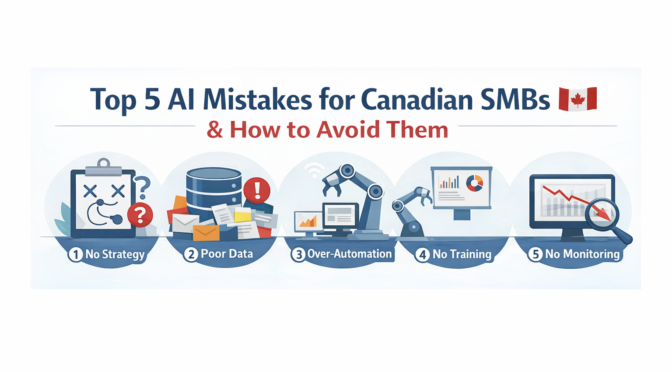
AI is no longer a luxury reserved for multinational tech giants. Across Canada, roughly 70% of SMBs now use some form of AI. However, many struggle to translate this experimentation into consistent productivity or measurable ROI. In most cases, the challenge isn’t the technology, it’s the implementation strategy.
Here are the five most common AI mistakes for Canadian SMBs and how to navigate them professionally.
1. Implementation Without a Business Strategy
Adopting AI just because it’s trending often leads to fragmented tools and wasted budget. Productivity gains are highest when AI is embedded into specific processes rather than treated as a generic experiment.
2. Overlooking Data Quality and Privacy Compliance
AI is only as reliable as the data behind it. Canadian firms must navigate a complex regulatory landscape, including PIPEDA, Quebec’s Law 25, and the emerging AIDA (Artificial Intelligence and Data Act), all requiring transparency and accountability.
3. Assuming AI is a Total Replacement for Staff
Over-reliance on full automation increases the risk of “hallucinations” (errors) and removes the personal touch that Canadian customers value. Furthermore, AIDA and Law 25 impose stricter obligations on decisions made exclusively by AI.
4. Neglecting Team Training and Culture
Even the best tools fail if the team doesn’t trust or understand them. A lack of internal skills and the fear of job displacement are primary barriers to scaling AI within Canadian SMBs.
5. Viewing AI as a “Set It and Forget It” Project
AI models require ongoing attention to remain effective. Business conditions and regulatory expectations, including federal standards under AIDA, are constantly evolving.


Leave a Reply