
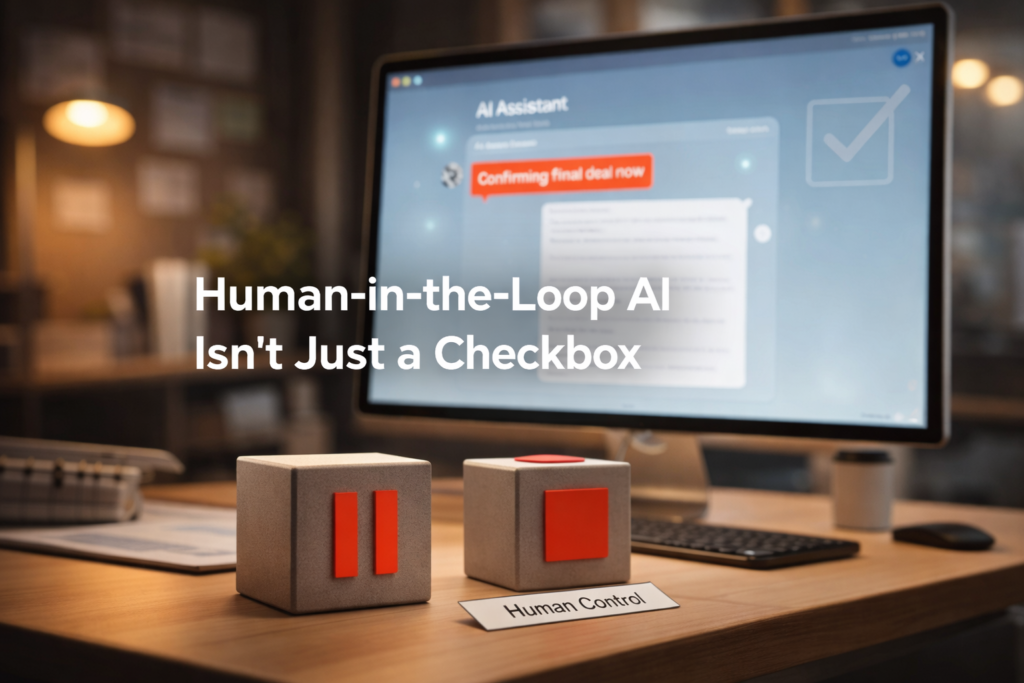
In early 2024, a small Chevrolet dealership added an AI chatbot to its website to answer sales questions. This is common today. Many small businesses use chatbots to handle customer inquiries.
What happened next was not expected.
A customer pushed the chatbot into confirming a deal for a new Chevy Tahoe for one dollar. The conversation was shared online and spread quickly. The dealership did not sell the vehicle, but the public reaction caused real embarrassment and loss of trust.
The problem was not the customer.
It was how the system was set up.
After situations like this, the explanation is often the same. A human was supposed to be watching. Staff were overseeing sales. The chatbot could not officially close a deal. But the system was still allowed to negotiate freely, without clear limits or someone watching it in real time.
That is not oversight.
That is relying on luck.
Being “in the loop” is not the same as being in control
Many businesses say humans are “in the loop.” What this usually means is that someone can step in after something goes wrong.
That is not control.
That is fixing mistakes after the fact.
If AI acts first and humans respond later, the system is making the real decisions. The human role becomes secondary, even if the process says otherwise.
This is how control slowly shifts without anyone meaning to give it up.
Where human judgment actually matters
Human oversight only works when it exists at the right moments.
Before using AI, someone must clearly decide what the system is allowed to do and what it is not allowed to do. In this case, the chatbot should never have been allowed to suggest prices or deals. That limit should have been clear from the start.
When AI output looks wrong, people must feel able to question it. If staff are rushed, discouraged, or unsure whether they are allowed to challenge the system, they will stop doing so.
When something goes wrong, someone must have clear authority to pause or shut the system down immediately. If this authority is not defined in advance, it will not be clear when problems appear.
The quiet failure most businesses miss
Most businesses do not lose control suddenly. They lose it slowly.
At first, people double-check the system. Over time, they trust it more. Eventually, they stop questioning it. Reviews become routine. Approvals become automatic.
Nothing dramatic happens.
That is why it is dangerous.
What real oversight looks like
Businesses that manage this well are very clear about responsibility. Everyone knows who can override the system and when. Questioning AI output is normal, not seen as a problem. Overrides are used to improve the system, not to blame people.
Most importantly, people who are responsible for outcomes are allowed to stop the system when needed.
In these situations, humans still own the decision. The AI supports the work, but it does not replace judgment.
Why this matters for small businesses
For small and mid-sized businesses, this issue is even more important. Tools are adopted quickly. Teams are small. Decisions happen fast.
If AI is used for pricing, handling leads, or communicating with customers, unclear authority creates real risk. Customers will not care that a bot made the mistake. They will see it as a business failure.
The bottom line
Human-in-the-loop is not a safeguard by itself. If people do not have clear authority and the ability to act at the right time, it does not reduce risk.
AI does not need bad intentions to cause problems.
Issues happen when systems are used without enough checks in place.
A note from BRUKD Consultancy
At BRUKD, we help organizations understand where AI fits into their decision-making and where human authority needs to be clearly defined before systems are used in real operations.
If you want a structured way to assess AI readiness, you can start here:
https://brukdconsultancy.com/assessment.html
If you would like to discuss your situation directly, you can contact us here:
https://brukdconsultancy.com/contact.html