
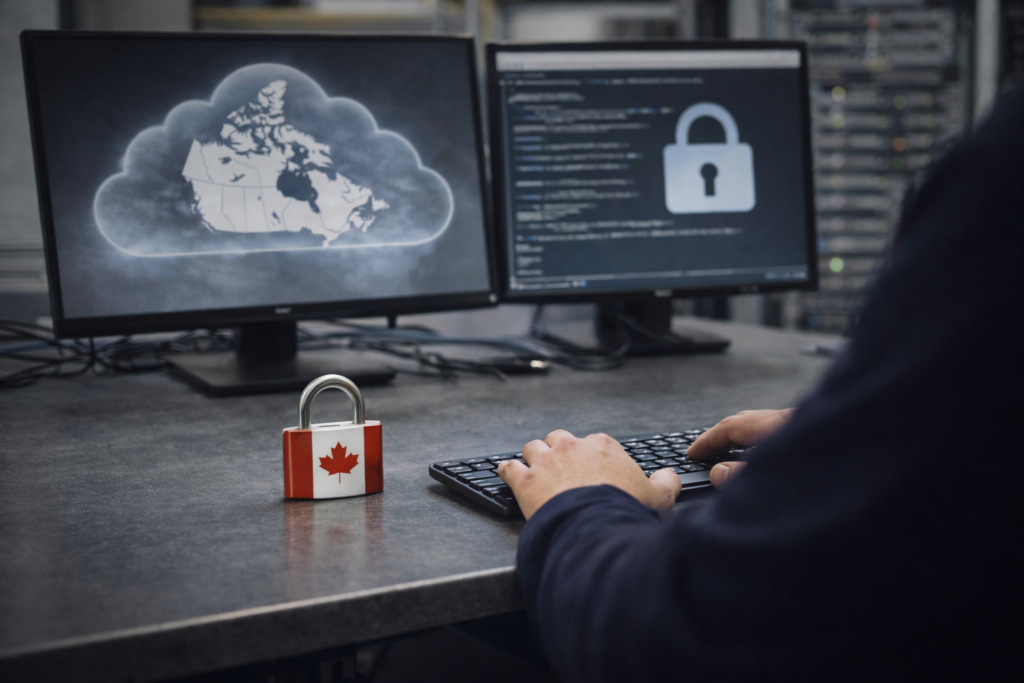
The Hidden Risks of Cloud AI for Canadian Businesses
By early 2026, a growing number of Canadian organizations began to voice a specific concern: what happens to the data sent to U.S.-hosted AI platforms? While we haven’t seen a wave of confirmed breaches, the conversation has highlighted a practical problem. Most businesses can’t say for sure where their AI-generated data is stored or which country’s laws actually govern it.
Why “The Cloud” Has Borders
The term “cloud” makes it feel like data is just floating everywhere at once. In reality, every piece of data lives on a physical server in a specific building. That location matters because it determines which national laws apply to your information.
For a firm in Toronto or Montreal handling client records or medical files, this isn’t just a technicality. It is about who has the right to look at your data and whether you still have total control over your most valuable business assets.
Three Risks You Might Not See
When Canadian companies use AI systems hosted outside our borders, they often run into a few specific governance issues:
- The Reach of Foreign Law: Under the U.S. CLOUD Act (2018), American authorities can request access to data stored with U.S. providers, even if that data belongs to a Canadian company. This creates a direct conflict with our own laws like PIPEDA or the upcoming Artificial Intelligence and Data Act (AIDA).
- The Training Loop: Many AI platforms default to using “de-identified” data to train their future models. Unless you have a very specific contract in place, the proprietary information you feed an AI today could end up helping a competitor’s model tomorrow.
- Provincial Compliance: Standards like Quebec’s Law 25 and shifting expectations in Ontario require you to prove where sensitive data is stored. If you have “incomplete visibility,” you likely won’t pass a modern privacy audit.
The Alternative: Keeping AI in Canada
You don’t have to give up on advanced AI to keep your data local. There are practical ways to get the best of both worlds.
What You Can Do Now
- Local Regions: Providers like AWS, Azure, and Google now have specific “Canada Central” or “Canada East” regions. You can configure your AI tools so the data never leaves these borders.
- Enterprise Privacy: Moving from free or consumer versions of AI to Enterprise APIs usually gives you “Zero Data Retention” guarantees.
- Private Setups: Some businesses are now running open-source models inside their own secure cloud environments, ensuring no data ever touches a public server.
The Shift Toward Sovereign AI
As we move through 2026, we are seeing the rise of Sovereign AI. This is a “local-first” approach where the heavy lifting happens in the cloud, but the sensitive “memory” of your business stays on Canadian soil. It is a more balanced way to innovate without taking on unnecessary risk.
The BRUKD View: How We Help
Moving to a secure AI setup is more than just a software update. It requires a clear strategy. At BRUKD, we help you close the gap between AI potential and Canadian regulatory requirements.
- Data Residency Audits: We look at your current AI tools to find out exactly where your data is traveling and identify your jurisdictional risks.
- Sovereign AI Strategy: We help you build “Hybrid” setups that use the power of the cloud while keeping your most sensitive data in Canada.
- Compliance Mapping: We translate complex rules like AIDA and Law 25 into a simple plan for your business.
- Vendor Review: We check the fine print in your AI contracts to make sure your data residency is actually guaranteed.
AI should be a tool that makes your business stronger, not a source of hidden legal risk. Knowing where your data lives is the first step toward making sure your company’s knowledge stays in your hands.
Want to see where your organization stands?
- Read the Evidence-Based AI book
- Take our AI Readiness Assessment
- Talk to the BRUKD team to discuss your specific data residency and compliance needs.