
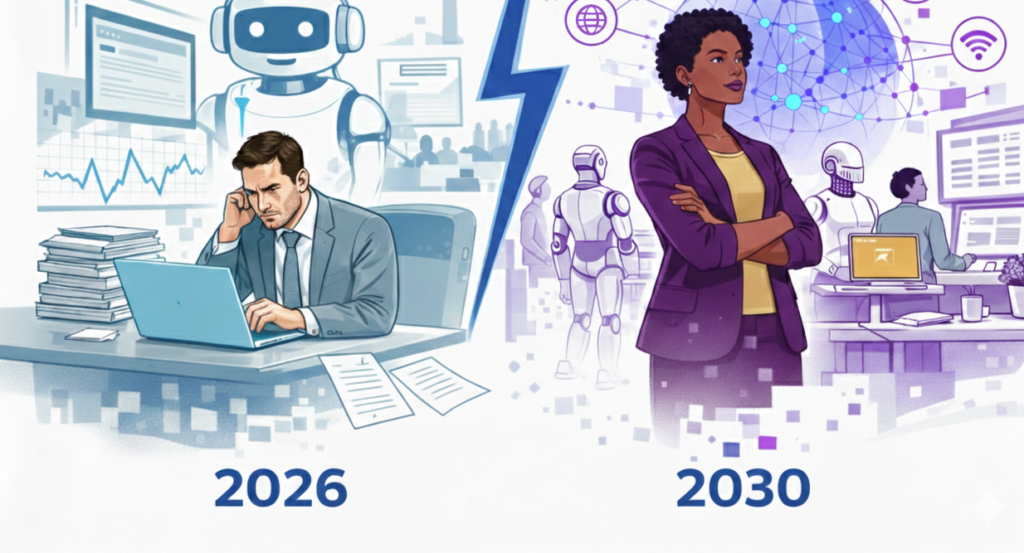
If you’re running a small or medium-sized business (SMB) today, the headlines about AI can feel like a mix of science fiction and a threat. But as we look toward 2030, the reality is much more grounded; it is also much more human. We are moving out of the era of “Doing,” where we trade hours for tasks, and into the Age of Orchestration, where we manage systems that do the tasks for us.
The Reality Check: 2026 vs. 2030
Right now, in 2026, we are in the “Plug-in” phase. You might use AI to draft an email or summarize a meeting, but it’s still clunky. It hallucinates, it’s disconnected, and it’s often more work to manage than it’s worth.
But the “thinking” cost of AI is dropping by half every few months. By 2030, AI won’t just be a tool you use; it will be the invisible engine of your business. The winners won’t be the ones with the flashiest software: they will be the ones who know how to lead a team of people who, in turn, lead a team of AI agents.
1. The Human Shift: 170 Million New Opportunities
There is a lot of talk about AI taking jobs. The data suggests that while about 90 million routine roles will change or disappear, 170 million new roles will be created. For a local business, this isn’t about firing your team; it’s about leveling them up.
- From Assistant to Architect: Your Admin Assistant won’t just file papers; they will become an Agent Orchestrator, managing digital “bots” that handle your scheduling, billing, and data entry.
- From Manager to Strategist: Your Marketing Manager won’t spend all day writing posts; they will become a Creative Strategist, using AI to generate 100 drafts in seconds so they can focus on the one that actually speaks to your customers’ hearts.
- The “Human Premium”: In 2030, the things AI can’t do, such as empathy, negotiation, complex ethics, and genuine relationship-building, will be your most expensive and valuable assets.
2. The Training Imperative: Don’t Hire New, Grow Within
In this environment, the most dangerous thing in your business is not a competitor; it is an outdated skillset. Multiple studies indicate that the “half-life” of many technical skills has dropped to roughly two to three years, meaning half of what an employee learns today may be partially outdated within that window.
Why training your current staff is your smartest financial move:
- It’s Cheaper: Recruiting and onboarding a new “AI expert” costs 3x more than reskilling the loyal person you already have.
- They Know Your “Secret Sauce”: AI can learn your workflow, but it doesn’t know your customers’ names, your town’s quirks, or why you started this business. Your current team holds that vital institutional memory.
- The 40% Rule: By 2030, 40% of the skills your team uses today will be obsolete. If you aren’t training them now, you are effectively losing 40% of your company’s power.
3. A Practical Roadmap for the 2030-Ready SMB
You don’t need a Silicon Valley budget to get ready. You just need a shift in mindset.
- Focus on Workflows, Not Tools: Stop chasing the newest app. Instead, look at a 5-step process (like onboarding a new client) and ask: “How can one human oversee three AI agents to do this in half the time?”
- Hire for Curiosity: The best employee in 2030 isn’t the one who knows the most; it’s the one who learns the fastest.
- Clean Up Your Data: Your customer history and operational data are the “fuel” for your future AI. Start organizing it now so you’re ready to use it later.
- Be the Face of Trust: In a world of automated “everything,” people will crave human accountability. Make sure your customers know that a real human is always the one in charge.
Imagine a 20-person trades or field service business that routes jobs using AI scheduling, generates quotes automatically from past jobs, and uses agents to chase overdue invoices; this infrastructure frees managers to focus on high-value relationships and business growth.
How Brukd Helps You Get There
At Brukd, we don’t believe in technology for technology’s sake. We help Canadian SMBs navigate this shift without losing their soul (or their budget). We focus on:
- Role Mapping: Turning your “doers” into “orchestrators.”
- Workflow Design: Creating AI-powered systems that actually work for your specific business.
- Skills Roadmaps: Building a training plan that ensures your team is ready for 2030, not stuck in 2024.
The “Great Talent Reshuffle” is here. Don’t just watch it happen: lead it.